
Software Engineering and Education (SEE) Research Group
We are a research group at Mid Sweden University focusing on **software engineering**, **software testing**, and **generative AI in development and education**.
Worldwide, there is an increasing demand for software professionals, and software engineers are the fifth most common profession in Sweden today. The SEE Research Group consists of social scientists and computer scientists with the goal of understanding how software is successfully created and how to best learn software development.
We are particularly invested into:
- The quality assurance of software and AI through testing and test augmentation (contact Felix Dobslaw)
- The gap between education and industry demands and the role of life-long learning (contact Lena-Maria Öberg)
- Forms of distance collaboration and their implications for individuals and organizations (contact Thomas Persson)
What we do
Applied research in software testing, trustworthy AI, and empirical studies of developer work and learning.
Who we are
Senior researchers, postdocs, and PhD students collaborating across software engineering and education.
Collaborate
Interested in collaborating with us or supervising a thesis project?
News
Discussion on AI impact on higher education at the NU conference
June 10, 2026
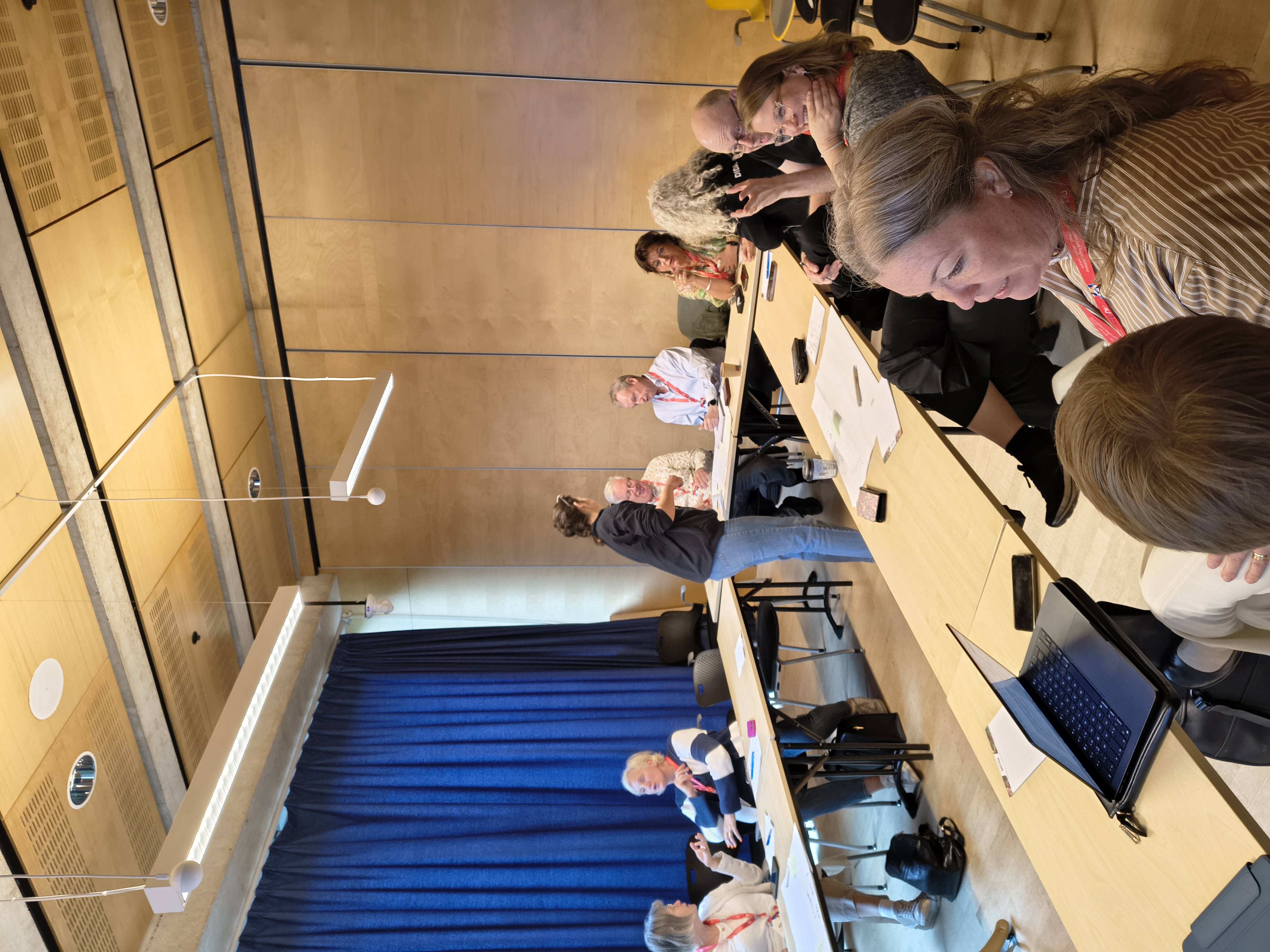
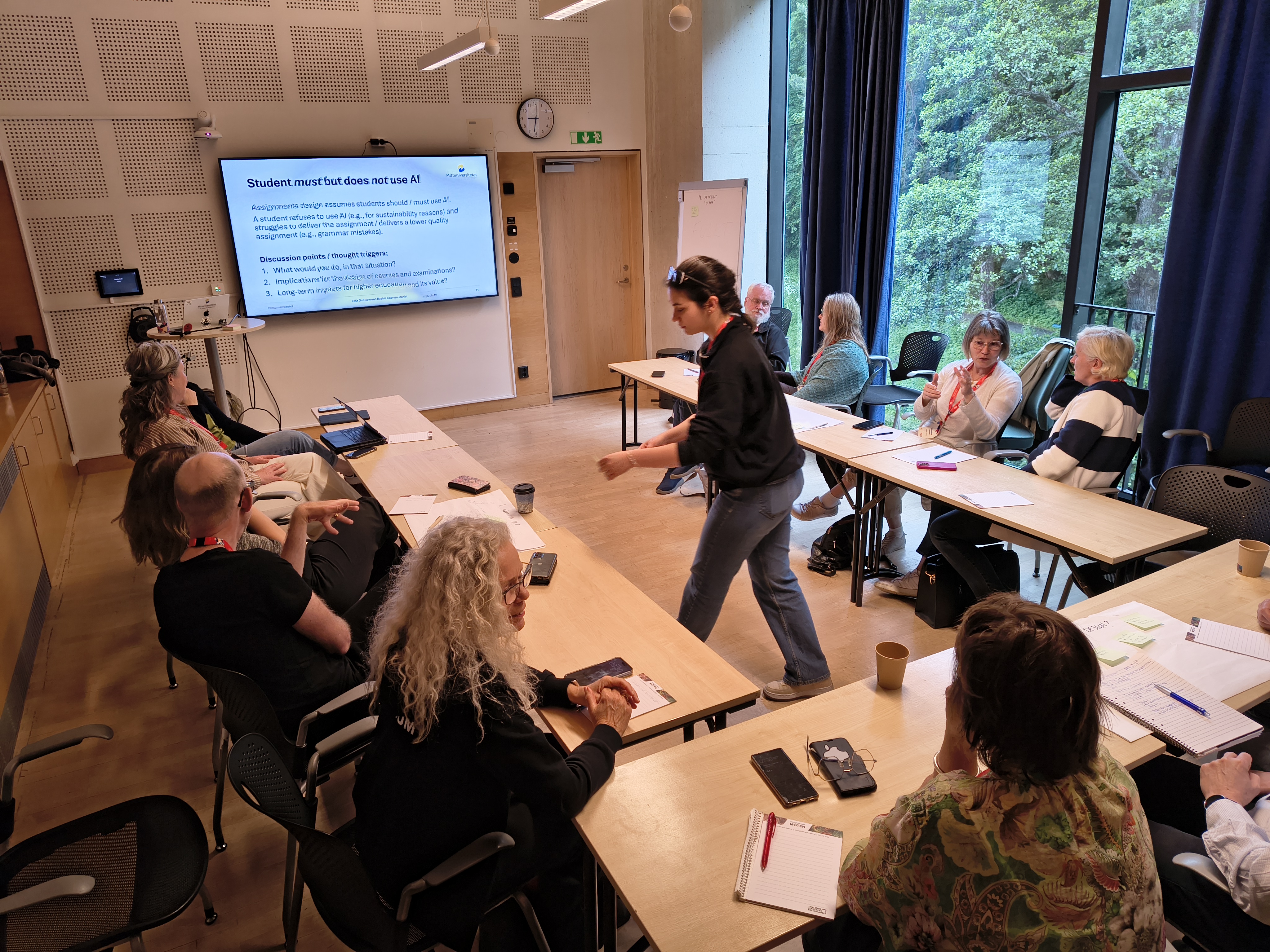
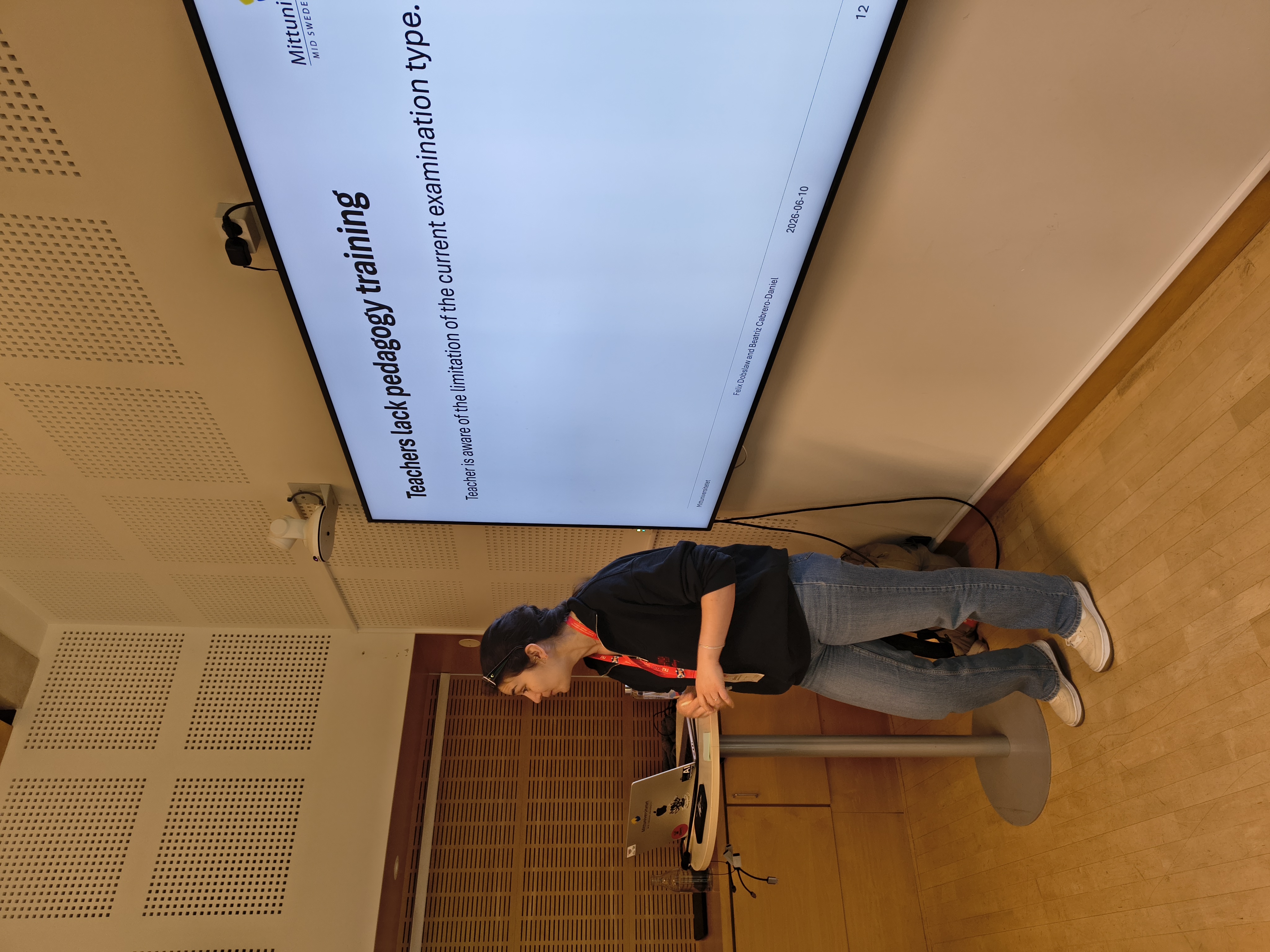
On 8-10 June 2026 the NU conference was held in Gothenburg, and some of us attended the conference to learn all about pedagogical advances in universities across the country. Moreover, Felix Dobslaw and Beatriz Cabrero-Daniel organised a roundtable discussion on the future of higher education in the era of Generative AI.
As you can see in the pictures, the participants’ views and experiences were gathered in sticky notes, and will soon be shared in a public repository with a unique Digital Object Identifier.
SEE group receives 6.9 MSEK ESF grant for SAIP – Software and AI Transformation Platform
June 4, 2026
Felix Dobslaw and Anna Sörensson have been awarded a 6.9 million SEK European Social Fund (ESF) grant, co-financed by Region Jämtland Härjedalen, for the three-year SAIP – Software and AI Transformation Platform project, starting in September 2026.
The project will establish a long-term arena for software development and AI in the Jämtland–Härjedalen region, bringing together businesses, the public sector, researchers, and students to develop new knowledge, build collaborations, and strengthen regional innovation capacity. Activities include needs analyses, workshops, and a participant-driven unconference, with engagement from the national software engineering research community.
See the announcement on LinkedIn →
Column published in IEEE Software on AI transformation readiness
May 20, 2026
Felix Dobslaw, together with Lucas Gren, Markus Borg, and Erik Sterner, has published a column in IEEE Software titled “AI Transformation: Ready or Already?”
The column argues that the outcomes of generative AI initiatives depend on readiness — not technology alone — and examines the organizational, individual, and technological dimensions that determine whether AI transformations succeed or fail. Published in IEEE Software, Volume 43, Issue 3, May–June 2026, pages 8–12. DOI →
Paper accepted in the IEEE International Conference on Intelligent Transportation Systems
May 19, 2026
Our paper “Similarity-metrics for fast retrieval of manoeuvrer data reduced to one dimension using Space Filling Curves” by Beatriz Cabrero-Daniel, who recently joined MIUN and SEE as Assistant Professor, Lydia Armini, and Christian Berger (from the University of Gothenburg and Chalmers University of Technology) has been accepted for publication in the IEEE International Conference on Intelligent Transportation Systems (ITSC)!
The paper summarises a computational methods study about similarity metrics for multidimensional data after encoding them into one dimension using Space-Filling Curves. The goal is to retrieve similar data points from large datasets under safety-critical real-time constraints. The link to the publication in IEEE Xplore will appear here shortly!
On Forecasting Truck Driving Manoeuvrers with Foundation Models for Time Series Data
May 18, 2026
The paper “On Forecasting Truck Driving Manoeuvrers with Foundation Models for Time Series Data” by Beatriz Cabrero-Daniel, Simon Börjesson (Lund University), Erik Ersmark (Lund University), Pierre Nugues (Lund University), Klara Eliasson (Volvo Group Trucks Technology), and Christian Berger (University of Gothenburg and Chalmers University of Technology) is now accepted for presentation in the IEEE International Conference on Intelligent Transportation Systems (ITSC) and pending publication in IEEE Xplore!
This paper presents a number of experiments with both synthetic and real data, we evaluated several foundation models for predicting time-series data (with Chronos-Bolt and PatchTST as the best-performing ones). It is interesting to note that while foundation models are very interesting tools to consider, in many cases they do not substantially outperform smaller deep learning models!
For more information about this project, please check the Vinnova website.